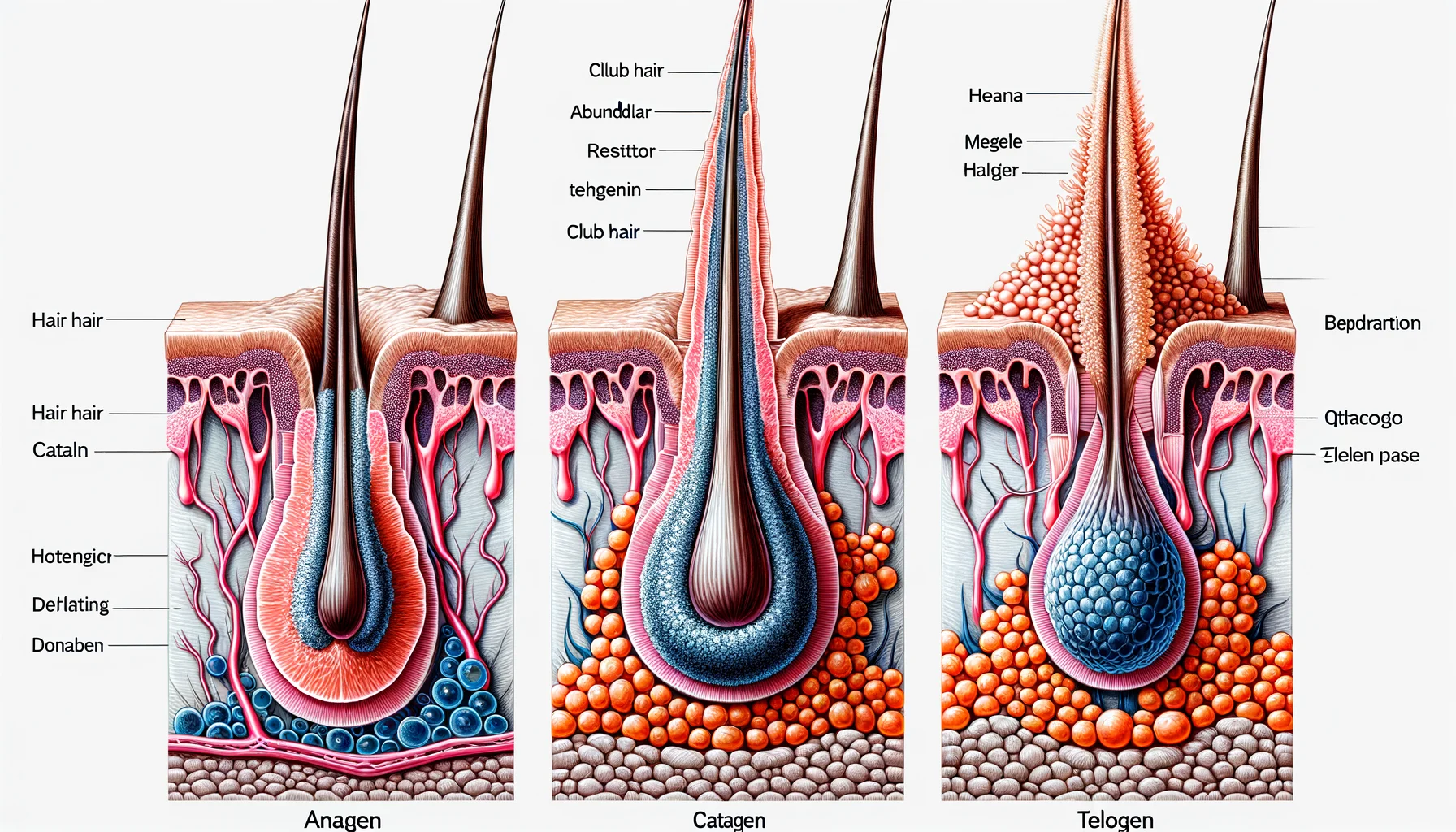
Success of laser hair removal depends entirely on understanding the human hair growth cycle. The laser can effectively destroy only hair in the anagen phase (active growth), representing only 20-30% of follicles at any given time. This biological reality explains why complete hair removal requires multiple sessions over several months, regardless of laser power used.
The Three Phases of the Hair Growth Cycle
The human hair growth cycle comprises three physiologically distinct phases, cycling continuously.
| Phase | Percentage | Duration | Characteristics | Laser sensitivity | Temperature response |
|---|---|---|---|---|---|
| Anagen (Growth Phase) | 80-85% of follicles | 3-7 years depending on body area |
| Highly sensitive - thermal destruction or apoptosis effective | Maximum absorption of laser energy (high melanin), easily reaches cytotoxic thresholds |
| Catagen (Regression Phase) | 2-3% of follicles | 2-3 weeks |
| Declining sensitivity - detaching hair less sensitive | Declining absorption (melanin declines), cytotoxic thresholds less easily reached |
| Telogen (Rest Phase) | 10-15% of follicles | 1-3 months depending on body area |
| Insensitive - club hair without follicle adherence | Little to no absorption (melanin absent), heat destroys nothing |
Why Laser Works Only During the Anagen Phase
The physical and biological properties of the anagen phase render hair specifically vulnerable to epilation lasers.
| Reason | Explanation |
|---|---|
| Maximum melanin content | During anagen, matrix cells actively produce melanin. This high melanin accumulation creates optimal absorption of laser photons. Hair in catagen/telogen phases contains progressively less melanin, reducing absorption and thermal efficacy. |
| Dermal papilla-hair adhesion | In anagen, the dermal papilla is firmly adherent to the matrix. This anatomophysiological proximity means heat generated in the hair rapidly transfers to the papilla. In telogen, the papilla is retracted and distant; heat from the club hair cannot reach it effectively. |
| Mitotic activity of matrix cells | In anagen, matrix cells divide very rapidly (24-48 hour cell cycle). These actively dividing cells are intrinsically more sensitive to thermal death and apoptosis. In catagen/telogen phases, cells do not divide, reducing this sensitivity. |
| Optimal follicular vascularization | The dermal papilla in anagen is highly vascularized to support rapid growth. This blood circulation creates a thermodynamically favorable environment for destruction (increased circulation increases local heating). In telogen, minimal vascularization offers less metabolic support. |
| Pro-apoptotic gene expression | Certain gene profiles favoring apoptosis are naturally more active late in the anagen phase. This is why laser-induced programmed apoptosis is more effective - it occurs in a context where pro-apoptotic genes are already partially activated. |
What Happens When Laser Is Applied at Each Phase
Predictable impact of laser application according to hair growth cycle phase.
| Phase | Outcome | Mechanism |
|---|---|---|
| Anagen | Effective destruction | Laser energy is absorbed by high melanin in hair. Temperature rapidly reaches 65-70°C (HR mode) or 45-50°C (SHR mode). At these temperatures: (1) immediate protein coagulation in matrix (HR mode) or (2) programmed apoptosis (SHR mode). The dermal papilla, adjacent to hair, undergoes the same heating and bulge stem cells are damaged. Result: permanent destruction of hair and follicle. |
| Catagen | Partial or uncertain destruction | Regressing hair contains less melanin (reduced production). Reduced laser absorption creates less heat. The retracting papilla is progressively less adjacent. Efficacy depends on exact timing within catagen (early vs late). Unpredictable result: may destroy follicle (if early catagen) or leave follicle intact (if late catagen). |
| Telogen | No destruction | Club hair contains very little or no melanin. Laser absorption is minimal. Even with high fluences, little heat is generated in hair. Dermal papilla is retracted at distance (0.5-1 cm below surface), out of the heating zone. Club hair may fall, but this is not laser destruction - it is natural hair shedding. The follicle remains intact and can generate new hair after several weeks. Result: no efficacy. |
Hair Cycle Parameters by Body Area
Variations in hair cycle between areas influence therapeutic strategy and session interval.
| Area | % Anagen | Anagen Duration (months) | % Telogen | Telogen Duration (months) | Optimal Session Interval |
|---|---|---|---|---|---|
| Upper lip | 65-75 | 3-4 | 10-15 | 1-2 | 4-6 weeks |
| Armpits | 80-85 | 4-6 | 10-15 | 2-3 | 6-8 weeks |
| Bikini line | 85-90 | 5-7 | 8-12 | 2-3 | 6-8 weeks |
| Legs | 70-80 | 4-6 | 15-20 | 2-3 | 4-6 weeks |
| Arms | 65-75 | 3-4 | 15-20 | 1-2 | 4-6 weeks |
| Back | 60-70 | 3-4 | 20-25 | 2-3 | 6-8 weeks |
| Chest | 65-80 | 4-5 | 15-20 | 2-3 | 6-8 weeks |
| Nape | 70-75 | 3-4 | 15-20 | 1-2 | 4-6 weeks |
Biology of Hair Follicle Stem Cells
Permanent destruction depends on inactivating bulge follicle stem cells, not simply destroying visible hair.
- Anatomical region of follicle located 1-2 mm below skin surface, containing quiescent stem cells
- Intersection of hair erector muscles (arrector pili muscle) with follicle
- Bulge stem cells — During each anagen cycle, these stem cells differentiate into matrix cells producing hair. At end of anagen, they become quiescent again.
- Mesenchymal structure located at follicle base in anagen phase, in direct contact with hair matrix
- Epithelio-mesenchymal inducer: provides growth and differentiation signals to matrix cells
- Extremely sensitive to thermal destruction - preserving intact dermal papilla = follicle regenerates
- Dermal papilla destruction is ESSENTIAL for permanent hair removal. Simple hair destruction without papilla = hair regrows
- Permanent reduction = long-term reduction in hair count. Does NOT mean total hair absence.
- Laser destroys certain bulge cells and dermal papilla. However: (1) not all bulge cells are destroyed (protection by intact adjacent cells), (2) follicles in catagen/telogen phases are not effectively treated, (3) even after destruction, very slight regrowth possible in following years.
- 80-90% permanent reduction = 80-90% of hair never regrows, but 10-20% may regrow. This reduction is 'permanent' in the sense that hair that does not regrow never will (unlike temporary hair removal). However, it is not complete elimination.
Why Complete Elimination (100%) Is Biologically Impossible
Multiple biological factors limit maximum efficacy to 80-90% permanent reduction.
Limitations
- Cycle synchronization variability — Follicles are NOT synchronized. At any given time, only 20-30% are in anagen. Genetic variability means certain follicles will enter anagen at unpredictable times after laser sessions. These follicles may escape treatment if the following session is not perfectly timed.
- Cellular heterogeneity — All bulge cells are not identical. Some bulge cells do not receive direct thermal energy (protected by adjacent cells). These cells may survive and generate hair months or years later. This is the biological mechanism of slight regrowth observed 2-5 years after laser hair removal.
- Thermoelectric hair removal — Even in anagen, some hair contains little melanin (genetically fine or hypopigmented). This hair absorbs little laser energy, remaining relatively spared. It is characterized by reduced efficacy (50-70% instead of 90%).
- Post-treatment hormonal factors — In certain patients, hormones (testosterone, androgens) continue to stimulate reactivation of residual follicles. This delayed regrowth (6-12 months after complete hair removal) is due to hormonal reactivation of surviving microscopic follicles, not laser failure.
- Follicular anatomical variation — Certain follicles are located in difficult-to-access zones (skin folds, curved areas). Laser penetration geometry may be non-optimal in these zones, reducing local efficacy. These 'difficult' follicles constitute approximately 5-10% of follicles.
Frequently Asked Questions
At 2 weeks, telogen follicles have not yet progressed sufficiently toward anagen phase. Only 5-10% additional follicles would be in anagen, reducing session efficacy. The optimal 4-6 week interval maximizes numbers of follicles entering anagen (~20-30% new).
No. Laser power does not change hair growth cycle biology. Even an ultra-powerful laser can only destroy hair in anagen phase. Hair in telogen phase remains insensitive to laser, regardless of fluence. However, very high fluences increase risk of burns and scars.
Optimal interval depends on area (4-6 weeks for most areas, 6-8 for armpits and bikini line). This interval corresponds to average biological time for telogen follicles to enter anagen. Shorter intervals = reduced efficacy (follicles not in anagen). Longer intervals = hair cosmetically visible regrowth.
This slight delayed regrowth is due to: (1) bulge cells not completely destroyed (cellular heterogeneity), (2) follicles in catagen/telogen phase at time of treatment (not entirely treated). These residual follicles survive and progressively reactivate. This is normal and explains why laser hair removal gives 80-90% permanent reduction, not 100%.
No. Even using best techniques, 10-20% of hair may regrow. This limitation is biological, not technical. Follicles in non-anagen phase at time of treatment, as well as certain protected stem cells, may escape laser. The term 'permanent hair removal' means 80-90% reduction, not total absence.
Sources scientifiques
- . The optics of human skin. Science (1983) ;220 (4596) :524-527 . PMID: 6836297
- . Hair follicle stem cells and skin physiology. J Cutan Aesthet Surg (2017) ;10 (1) :34-39 .
- . Extended theory of selective photothermolysis with application to laser hair removal. Lasers Surg Med (2001) ;29 (5) :416-432 . PMID: 12030874
- . Evidence-based review of hair removal using lasers and light sources. J Eur Acad Dermatol Venereol (2006) ;20 (1) :9-20 . PMID: 16405602
- . Evaluation of long-term effects of laser hair removal. Dermatol Surg (2013) ;39 (3) :446-451 .
Vous souhaitez en savoir plus ?
Contactez nos experts pour une démonstration personnalisée des appareils NeoCure.
Demander une démonstration