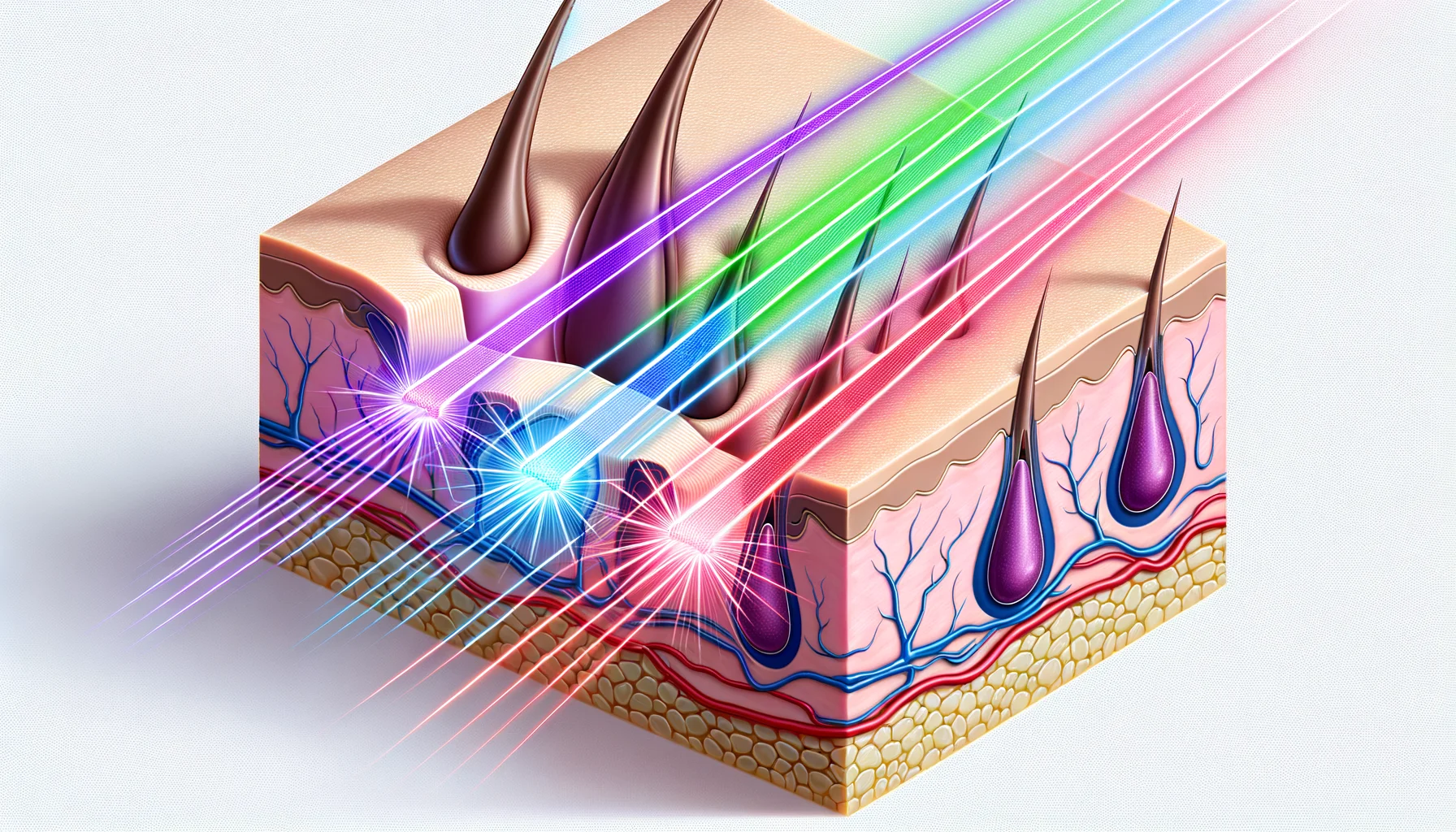
Definition
A multi-wavelength laser system is a platform combining several lasers or light energy sources operating at different wavelengths (typically 755nm/808nm/940nm/1064nm) in a single device. This approach exploits the specific advantages of each wavelength, optimizing spectral coverage, overall efficacy and adaptability to all hair types, phototypes and anatomical zones.
Spectral synergy concept
Spectral synergy is based on the principle that each wavelength possesses distinct optical and biological properties:
- Shorter wavelengths (755nm Alexandrite): high melanin absorption, moderate penetration (1-2mm), excellent efficacy on fine/blonde hair, light phototypes (I-III)
- Intermediate wavelengths (808nm, 940nm diodes): absorption/penetration balance, phototype versatility (I-V), stable efficacy on all hair types
- Longer wavelengths (1064nm Nd:YAG): deep penetration (3-6mm), reduced melanin absorption, dark phototype safety (IV-VI), reduced efficacy but excellent tolerance
By combining these wavelengths, a treatment session can simultaneously or sequentially target different hair classes and follicular depths, improving overall reduction by 10-20% compared to single-wavelength use.
Technical parameters by wavelength
Optimized spectral characteristics for multi-wavelength hair removal:
| wavelength_nm | wavelength_name | absorption_coefficient_cm | penetration_depth_mm | optimal_phototypes | optimal_hair_type | fluence_range | pulse_width_ms | speed_advantage | key_benefit |
|---|---|---|---|---|---|---|---|---|---|
| 755 | Alexandrite | 180 | 1.0-2.0 | I-III | Fine to medium, light to dark hair | 10-18 J/cm² | 3-20 | Fast (high frequency) | Excellent melanin absorption, speed |
| 808 | Diode (standard) | 136 | 1.5-3.0 | I-V | All types, optimal efficacy on medium/thick | 10-40 J/cm² | 5-100 | Very fast (high power) | Versatility, efficacy, depth |
| 940 | Diode (near-IR) | 96 | 2.0-4.0 | III-VI | Deep hair, dark phototypes | 10-40 J/cm² | 5-100 | Very fast (high power) | Maximum penetration, phototype VI safety |
| 1064 | Nd:YAG | 70 | 3.0-6.0 | IV-VI | All types, priority for dark phototypes | 100-200 J/cm² | 10-300 | Modulated (precision control) | Extreme depth, phototype VI tolerance |
Multi-wavelength combination strategy
For optimal hair removal covering all hair types, depths and phototypes:
| Target | Recommended wavelengths | Rationale | Expected efficacy improvement |
|---|---|---|---|
| Fine/blonde/light hair | 755nm + 808nm | 755nm compensates low melanin absorption with shorter wavelengths; 808nm adds penetration for deep bulbs | +15-20% vs single wavelength |
| Thick/dark hair, phototypes I-III | 808nm + 1064nm (low fluence) | 808nm primary efficacy; 1064nm complements penetration and tolerability | +10-15% vs single wavelength |
| Thick/dark hair, phototypes IV-V | 808nm + 940nm | Two complementary diodes: 808nm for absorption, 940nm for safe depth | +10-15% vs single wavelength |
| All hair, all phototypes (universal treatment) | 755nm + 808nm + 940nm + 1064nm | Maximum spectral coverage of the therapeutic spectrum; each wavelength optimized for a subgroup | +20-30% vs single wavelength, better homogeneity |
| Phototypes VI (very dark) | 940nm + 1064nm (long pulse, low fluence) | Safe wavelengths: moderate melanin absorption, penetration helps reach deep hair | +10-12% vs single 1064nm |
Multi-spectral coverage analysis
Each wavelength targets different depths and hair classes:
DEPTH
755nm = 1-2mm (follicular epithelium, fine terminal hair). 808nm = 1.5-3mm (terminal hair bulbs, follicular bulge). 940nm = 2-4mm (deep bulbs, cellular reserves). 1064nm = 3-6mm (deep structures, phototype VI).
HAIR TYPE
Fine hair (diameter < 0.5mm, low absorption) benefits from 755nm. Medium hair (0.5-1mm) optimized with 808nm. Thick hair (> 1mm, high absorption) effective with 755nm-808nm. Deep or curved hair requires 940nm-1064nm.
HAIR CYCLE PHASE
Anagen hair (active growth phase, concentrated melanin): all wavelengths effective. Catagen/telogen hair (dispersed melanin): reduced efficacy for all wavelengths, but cumulative chances of reaching each follicle increase with 4 wavelengths.
INDIVIDUAL VARIABILITY
Melanin absorption wavelength distribution varies by genotype. The multi-spectral approach increases the probability of each follicle interacting with its genetically optimal wavelength.
Multi-wavelength mode technical parameters
Typical multi-wavelength session configuration:
| phase | parameters |
|---|---|
| Preparation and testing | Test patch 24h before: apply each wavelength at moderate fluence on identical zone, observe reactions, document erythema and resolution timing |
| 755nm treatment | Fluence 12-16 J/cm², frequency 2-3 Hz, pulse 3-10ms. Minimal overlap. Observation of mild-moderate immediate erythema. Duration: 30-40% of total time |
| 808nm treatment | Fluence 20-30 J/cm², frequency 3-5 Hz, pulse 10-30ms. Minimal overlap. Observation of mild-moderate erythema. Duration: 30-40% of total time |
| 940nm treatment (if applicable) | Fluence 20-30 J/cm² (moderate for dark phototypes), frequency 2-4 Hz, pulse 15-50ms. Duration: 15-20% of total time |
| 1064nm treatment (if applicable) | Fluence 100-150 J/cm² (very low for phototypes IV-V), 60-100 J/cm² (phototypes VI), frequency 1-2 Hz, pulse 20-300ms. Duration: 10-20% of total time |
| Post-treatment | Overall erythema assessment, soothing gel application, recommendations identical for all wavelengths. Total session duration: 30-60min depending on surface area |
Frequently asked questions
Each wavelength optimizes a different hair type/depth. 755nm = fine light hair. 808nm = versatile. 940nm = deep hair. 1064nm = dark phototypes. The combination increases overall efficacy by 20-30%, treatment homogeneity, and adaptability.
Not if fluences are adjusted for the phototype. Cumulative energy may increase transient erythema but serious events (burn, depigmentation) remain < 1% with appropriate parameters. Key: start with conservative fluences, increase progressively.
Optimal order is debated: ascending approach (755-808-940-1064) starts with high absorption then completes depth (usual). Descending approach possible: 1064 starts with depth, then shorter wavelengths complete the surface (less common).
Not directly. Interference mainly comes from thermal accumulation: multiple rapid pulses = higher overall temperature rise. Management by: spacing applications (wait for partial erythema resolution between 2 wavelengths), moderate fluences, inter-application cooling.
Yes with strictly adjusted parameters: 1064nm fluence 60-100 J/cm² (ultra-low), 940nm fluence 15-20 J/cm² (very moderate), long pulses (100-300ms), low frequency (1-2Hz). Always perform a 24h test patch first. Technique is imperative.
Sources scientifiques
- Anderson RR, Parrish JA. Selective photothermolysis. Science (1983) ;220 (4596) :524-527 . PMID: 6836297
- Altshuler GB et al.. Extended theory of selective photothermolysis. Lasers Surg Med (2001) ;29 (5) :416-432 . PMID: 12030874
- Haedersdal M, Wulf HC. Evidence-based review of hair removal using lasers and light sources. J Eur Acad Dermatol Venereol (2006) ;20 (1) :9-20 . PMID: 16405602
- Gan SD, Graber EM. Laser hair removal: a review. Dermatol Surg (2013) ;39 (6) :823-838 . PMID: 23332016
- Ibrahimi OA et al.. Laser hair removal. Dermatol Ther (2011) ;24 (1) :94-107 . PMID: 21276162
Vous souhaitez en savoir plus ?
Contactez nos experts pour une démonstration personnalisée des appareils NeoCure.
Demander une démonstration