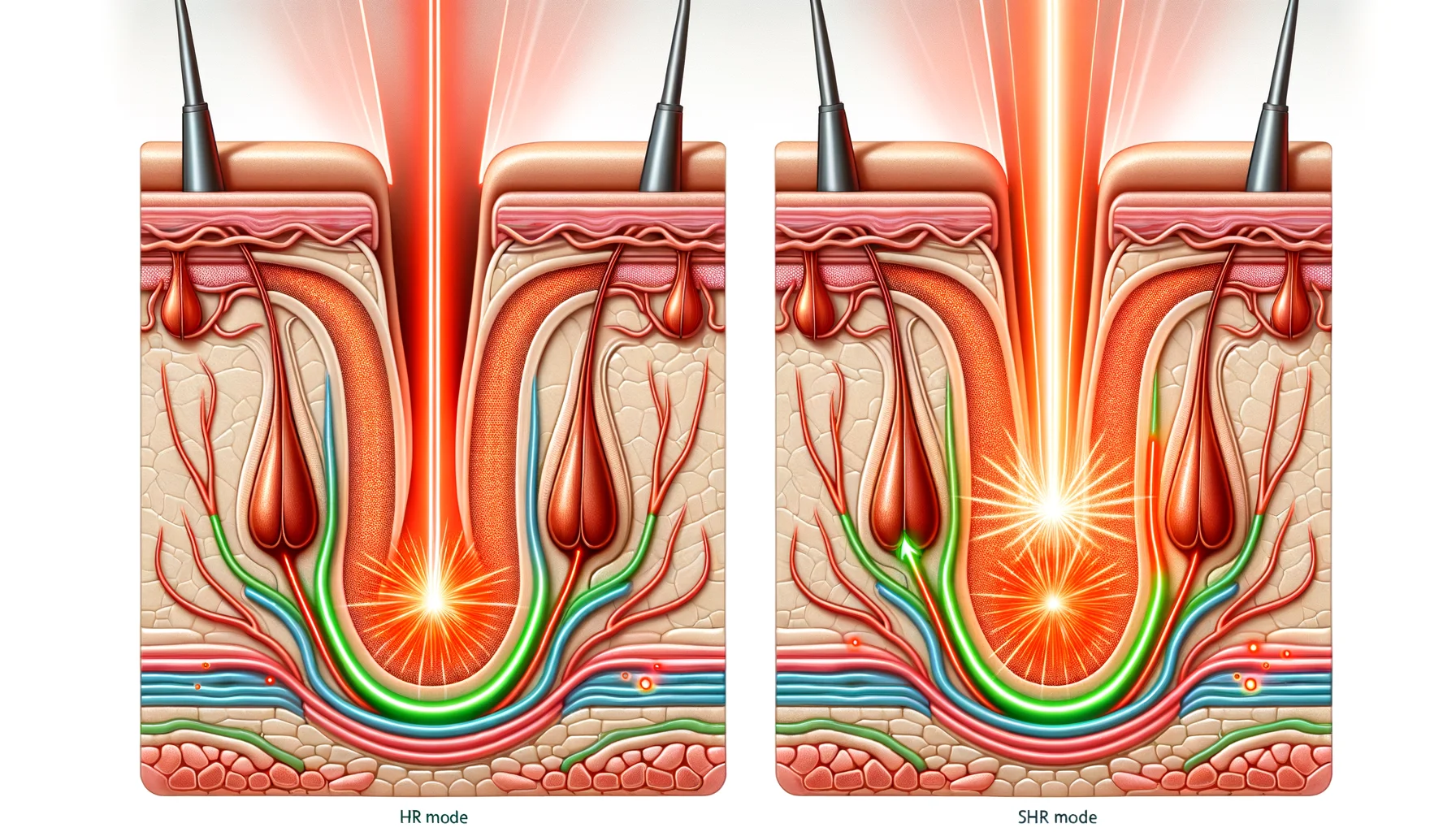
Laser hair removal uses two fundamentally different technological approaches: HR mode (High-fluence) based on classic selective photothermolysis, and SHR mode (Super Hair Removal) based on progressive thermal accumulation. These two methods offer distinct treatment profiles suited to different clinical contexts and phototypes.
HR Mode (High-fluence)
HR mode (High-fluence) represents the traditional application of the selective photothermolysis principle described by Anderson and Parrish. This approach uses high fluences (20-40 J/cm²) delivered in a single pulse, creating a rapid and significant thermal elevation in the hair follicle.
- High fluence: 20-40 J/cm²
- Single pulse per site
- Pulse duration: 10-100 ms depending on wavelength
- Instantaneous follicle heating
- Mechanism: direct thermal destruction of the dermal papilla
SHR Mode (Super Hair Removal)
SHR mode uses a radically different approach based on progressive thermal accumulation. This technique combines reduced fluences (5-10 J/cm²) with a very high repetition rate (10 Hz or more), creating a gradual heating effect on the follicle.
- Reduced fluence: 5-10 J/cm²
- Repetition rate: 10 Hz or more
- Multiple rapid pulses on the same site
- Thermal accumulation: temperature progresses up to ~48°C
- Mechanism: cellular apoptosis without tissue ablation
Step-by-Step SHR Mode Mechanism
The efficacy of SHR mode relies on a physiological process distinct from classic photothermolysis.
- The first low-energy pulse (5-10 J/cm²) is delivered to the site. This energy alone is insufficient to destroy the follicle but creates initial local heating.
- Subsequent rapid pulses (spaced 100 ms apart at 10 Hz frequency) add thermally before the previous heat has fully dissipated. The follicle and surrounding structures gradually accumulate energy.
- The follicle temperature rises progressively, reaching thresholds of 45-50°C after several pulses. Unlike HR mode where the temperature reaches 65-70°C in milliseconds.
- At this moderate temperature, apoptosis (programmed cell death) is induced in the follicle matrix cells and the dermal papilla without violent tissue ablation.
- Unlike HR mode, the epidermis does not experience sufficient thermal elevation to cause ablation. This difference explains the significant reduction in discomfort and side effect risk.
Comparison: HR Mode vs SHR Mode
Overview of parametric and clinical differences.
| Parameter | HR Mode | SHR Mode |
|---|---|---|
| Fluence (J/cm²) | 20-40 | 5-10 |
| Number of pulses | 1 per site | Multiple (5-10+) |
| Repetition rate (Hz) | ≤1 | 10 or more |
| Pulse duration (ms) | 10-100 | 2-10 |
| Peak temperature (°C) | 65-70 | 45-50 |
| Primary mechanism | Direct thermal coagulation | Thermal accumulation + apoptosis |
| Thermal epilation | Yes, significant | Minor |
| Risk of epidermal ablation | Higher | Reduced |
| Pain level | High (6-7/10) | Reduced (2-3/10) |
| Treatment time per zone | Longer | Faster |
| Hair removal efficacy (reduction) | 85-90% | 85-90% |
| Phototype range | I-IV | I-VI |
| Requires dermal cooling | Yes, critical | Less demanding |
| Risk of post-inflammatory dyschromia | Moderate to high | Low |
Real Clinical Data
Comparison of clinical experience between the two modes.
- Pain Assessment
- Comparative clinical studies on discomfort experienced during treatment.
- Hair Removal Efficacy
- Visible hair count reduction after complete treatment series.
Frequently Asked Questions
SHR mode offers superior safety for phototypes IV-VI. Progressive thermal accumulation reduces the risk of epidermal burns. However, HR mode can also be used on dark skin with specific parameters (1064 nm wavelength, reduced fluences, enhanced cooling).
No. Clinical studies show equivalent efficacy (85-90% reduction) for both modes. The difference lies in the tolerance profile and patient comfort, not in the final hair removal efficacy.
The progressive thermal accumulation of SHR reaches more moderate temperatures (~48°C) compared to HR (~70°C). This difference, though seemingly minor, significantly reduces stimulation of cutaneous nociceptors responsible for pain sensation.
No, the number of sessions for complete hair removal remains identical (6-8 sessions). However, the interval between sessions can be reduced (2-3 weeks instead of 4-6 weeks) due to better tolerability.
Yes, SHR is applicable to all Fitzpatrick classification phototypes (I-VI), while HR has limitations on phototypes V-VI without significant parametric adjustments.
Sources scientifiques
- . The optics of human skin. Science (1983) ;220 (4596) :524-527 . PMID: 6836297
- . Extended theory of selective photothermolysis. Lasers Surg Med (2001) ;29 (5) :416-432 . PMID: 12030874
- . Hair removal with an 808-nm diode laser: Evaluation of long-term efficacy and safety. J Cosmet Laser Ther (2008) ;10 (1) :24-33 . PMID: 18330795
Vous souhaitez en savoir plus ?
Contactez nos experts pour une démonstration personnalisée des appareils NeoCure.
Demander une démonstration